
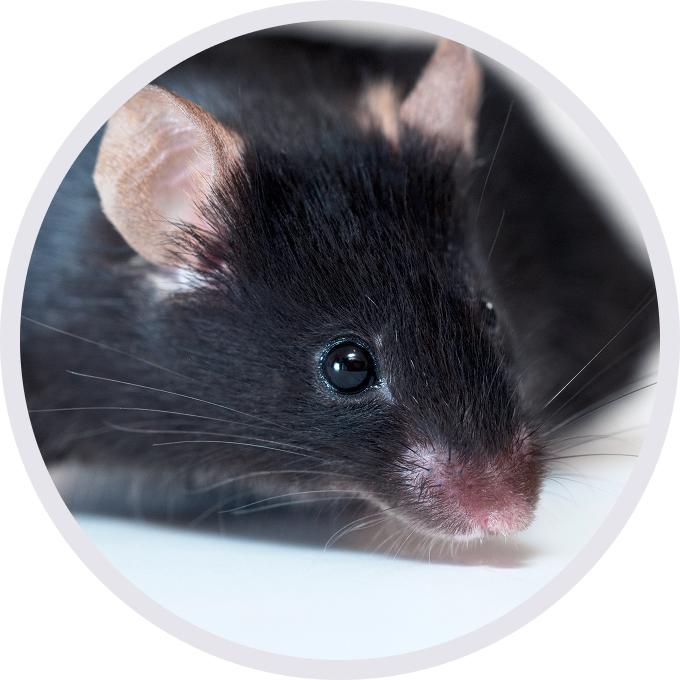
C57BL/6JNifdc-Igs2tm1(Alb-SERPINA1*E342K)Bcgen/Bcgen • 113041
| Product name | B-hSERPINA1*E342K mice |
|---|---|
| Catalog number | 113041 |
| Strain name | C57BL/6JNifdc-Igs2tm1(Alb-SERPINA1*E342K)Bcgen/Bcgen |
| Strain background | C57BL/6JNifdc |
| NCBI gene ID | (Human) |
| Aliases | PI; A1A; AAT; PI1; A1AT; nNIF; PRO2275; alpha1AT |


Gene targeting strategy for B-hSERPINA1*E342K mice. The exons 2-5 of human SERPINA1*E342K, including 3’UTR that driven by Alb promoter are inserted into mouse Hipp11 (H11) locus in B-hSERPINA1*E342K mice.

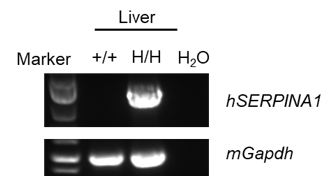
Strain specific analysis of SERPINA1 mRNA expression in wild-type C57BL/6 mice and B-hSERPINA1* E342K mice by RT-PCR. Liver RNA was isolated from wild-type C57BL/6JNifdc mice (+/+) and homozygous B-hSERPINA1*E342K mice (H/H), then cDNA libraries were synthesized by reverse transcription, followed by PCR with human SERPINA1 primers. Human SERPINA1 mRNA was detectable only in homozygous B-hSERPINA1*E342K mice but not in wild-type mice.
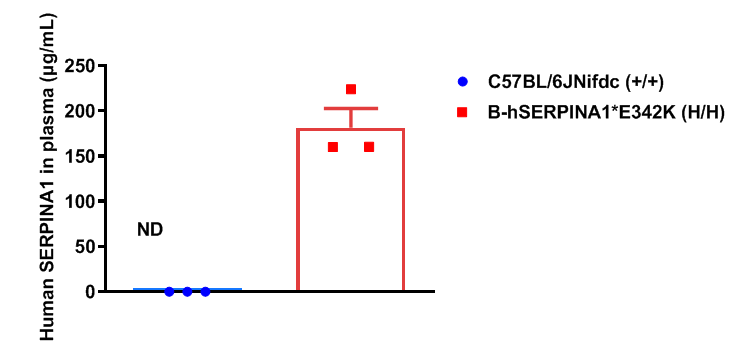
Strain specific SERPINA1 expression analysis in wild-type C57BL/6JNifdc mice and homozygous humanized B-hSERPINA1*E342K mice by ELISA. Plasma was collected from wild-type C57BL/6JNifdc mice (+/+) (male, n=3, 6-week-old) and homozygous B-hSERPINA1*E342K mice (H/H) (male, n=3, 6-week-old). Expression level of human SERPINA1 was analyzed by ELISA (anti-human alpha 1 Antitrypsin ELISA kit: Abcam, ab108799). Human SERPINA1 was exclusively detectable in homozygous B-hSERPINA1*E342K mice (n=3). Values are expressed as mean ± SEM.

Strain specific analysis of SERPINA1 gene expression in wild-type C57BL/6JNifdc mice and B-hSERPINA1*E342K mice by RT-qPCR. Liver RNA were isolated from wild-type C57BL/6JNifdc mice (+/+) (female and male, 7-week-old, n=3) and homozygous B-hSERPINA1*E342K mice (H/H) (female and male, 7-week-old, n=3). Values are expressed as mean ± SEM. ND: Not Detectable.

Strain specific analysis of SERPINA1 gene expression in wild-type C57BL/6JNifdc mice and B-hSERPINA1*E342K mice by RT-qPCR. Lung RNA were isolated from wild-type C57BL/6JNifdc mice (+/+) (female and male, 7-week-old, n=3) and homozygous B-hSERPINA1*E342K mice (H/H) (female and male, 7-week-old, n=3). Values are expressed as mean ± SEM. ND: Not Detectable.
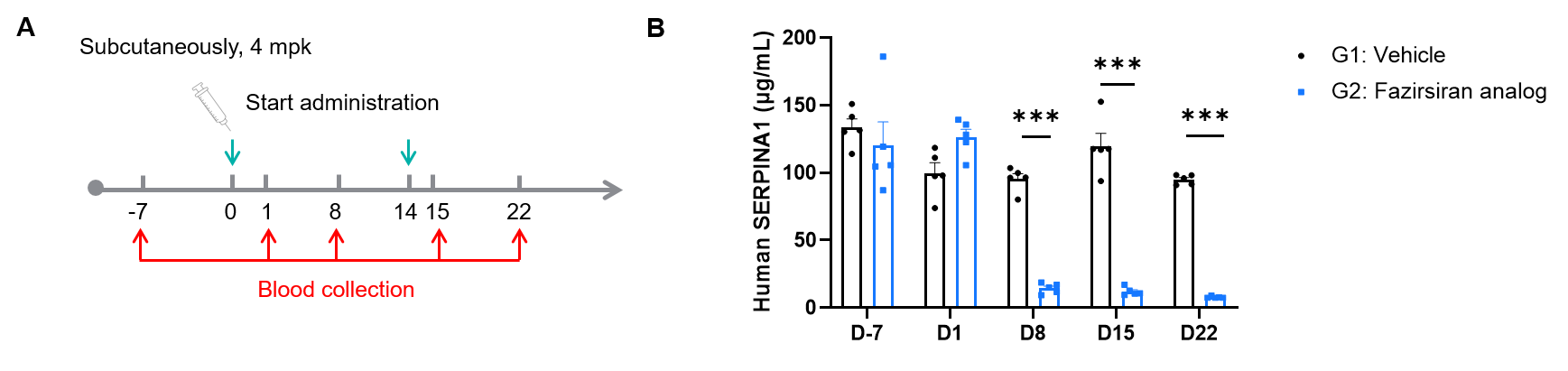
The inhibitory efficiency of the nucleic acid drugs against human SERPINA1 in B-hSERPINA1*E342K mice. B-hSERPINA1*E342K mice (female, 8-week-old) were randomly divided into two groups (n=5). The human SERPINA1 targeted nucleic acid drugs, Fazirsiran analog (4 mg/kg, Day 0 and 14, purchased from MCE, HY-132604A) and vehicle (0.9% Saline) were administered to the mice individually and serum samples were collected at the indicated time points (Days -7, 1, 8, 15, 22). (A) Schematic timeline of the in vivo experimental procedure. (B) Human SERPINA1 protein concentrations (μg/mL) measured in serum samples from G1 (vehicle) and G2 (Fazirsiran-analog) groups at each time point. Human SERPINA1 protein was significantly decreased after Fazirsiran analog dosage and B-hSERPINA1*E342K mice can be used in small nucleic acid drug screening research. Significance was determined by t-test, ***P<0.001. Values are expressed as mean ± SEM.
