Description
Introduction:
- The Pkd1 gene encodes polycystin‑1 (PC1), a transmembrane receptor critical for maintaining renal tubular structure, ciliary signaling, and normal epithelial cell proliferation and differentiation. Although designated R3277C in the mouse model to match the human variant nomenclature, this mutation affects the homologous residue at position 3269 in the mouse PC1 protein. This missense mutation disrupts the normal function of polycystin‑1, leading to dysregulated cell growth, abnormal tubular dilation, and progressive cyst formation in the kidneys, thereby faithfully recapitulating the core pathological features of human polycystic kidney disease.
Gene targeting strategy:
- The amino acid at position 3269 is mutated from Arginine (R) to Cysteine (C) in B-Pkd1*R3277C mice.
mRNA expression analysis:
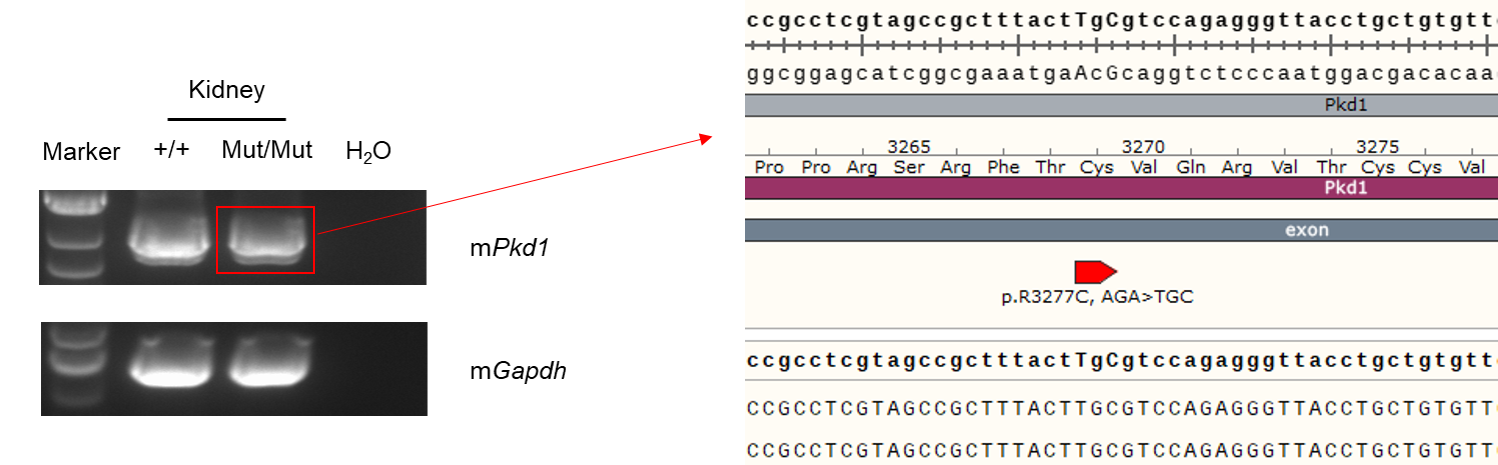
- Mouse Pkd1 mRNA was both detectable in C57BL/6JNifdc and homozygous B-Pkd1*R3277C mice, and the point mutation was confirmed via Sanger sequencing.
Application:
- B-Pkd1*R3277C mice is a well‑established mouse model for autosomal dominant polycystic kidney disease (ADPKD). This product is used for pharmacodynamics and safety evalsuation of kidney diseases such as ADPKD.
Targeting strategy
Gene targeting strategy for B-Pkd1*R3277C mice. The amino acid at position 3269 is mutated from Arginine (R) to Cysteine (C) in B-Pkd1*R3277C mice.
mRNA expression analysis
Strain specific analysis of Pkd1 mRNA expression in wild-type C57BL/6JNifdc and B-Pkd1*R3277C mice by RT-PCR. Kidney RNA were isolated from wild-type C57BL/6JNifdc (+/+) and homozygous B-Pkd1*R3277C mice (H/H), then cDNA libraries were synthesized by reverse transcription, followed by PCR with mouse Pkd1 primers. Mouse Pkd1 mRNA were both detectable in C57BL/6JNifdc and homozygous B-Pkd1*R3277C mice, and the point mutation was confirmed via Sanger sequencing.
* When publishing results obtained using this animal model, please acknowledge the source as follows: The animal model [B-Pkd1*R3277C mice] (Cat# 114750) was purchased from Biocytogen.