• B-hCD47/hGPC3 MC38

    • 322406

    B-hCD47/hGPC3 MC38

    Product nameB-hCD47/hGPC3 MC38
    Catalog number322406
    Strain backgroundC57BL/6
    NCBI gene ID (Human)
    AliasesIAP; Itgp; 9130415E20Rik; B430305P08Rik; OCI-5
    TissueColon
    DiseaseColon carcinoma
    SpeciesMouse

    在此页面上

    • Description
    • Phenotypic analysis
    • Physiological data

    海报

    查看全部

      发表文章

        Description
        • Origin: The MC38 cell line is derived from C57BL/6 murine colon adenocarcinoma cells. The cell line is a commonly used murine model for colorectal carcinoma.
        • Background Information: CD47, also known as integrin-associated protein (IAP), is a member of the immunoglobulin superfamily containing a five-pass transmembrane attachment. CD47 is heavily glycosylated and widely expressed by hematopoietic and nonhematopoietic cells. CD47 interacts with several membrane integrins and also acts as a receptor for thrombospondin (THBS1). Glypicans (GPCs) are a family of glycosylphosphatidylinositol (GPI)-anchored heparan sulphate proteoglycans (HSPGs) that may play a role in the control of cell division and growth regulation.
        • Gene targeting strategy: The exogenous promoter and human GPC3 coding sequence was inserted to murine Rosa26 site. The exogenous promoter and human CD47 coding sequence was inserted to replace part of murine exon 2 and all of exon 3. The insertion disrupts the endogenous murine Cd47 gene, resulting in a non-functional transcript.
        • Tumorigenicity: Confirmed in B-hGPC3 mice.
        • Application: B-hCD47/hGPC3 MC38 tumor models can be used for preclinical evalsuation of bispecific antibody drugs targeting human CD47 and GPC3.
        • Notes: The B-hCD47/hGPC3 MC38 cell line fails to form tumors in B-hSPRIA/hCD47 mice, suggesting that this cell line may also not form tumors in wild-type C57BL/6 mice. We recommend using the B-hCD47/hGPC3 MC38 #1-B06 cell line for tumor formation or efficacy studies in GPC3-related humanized mice.
        Protein expression analysis

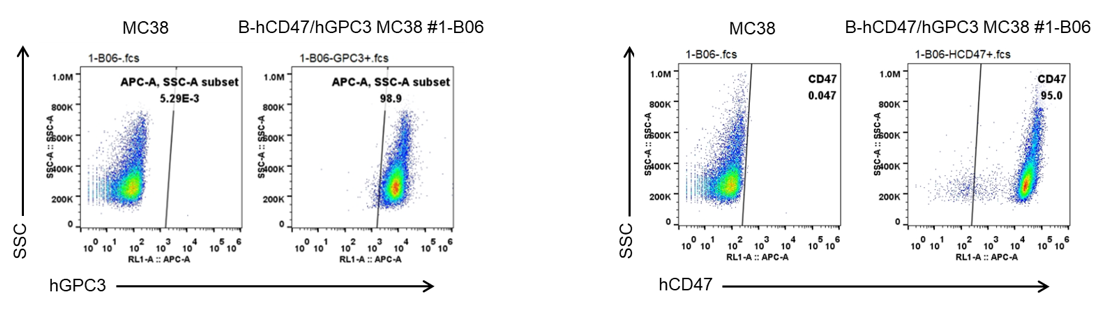
        GPC3 and CD47 expression analysis in B-hCD47/hGPC3 MC38 cells by flow cytometry. Single cell suspensions from wild-type MC38 and B-hCD47/hGPC3 MC38 #1-B06 cultures were stained with species-specific anti-GPC3 antibody (Invitrogen, MA5-40988) and species-specific anti-CD47 antibody (Biolegend, 323124). Human GPC3 and CD47 were detected on the surface of B-hCD47/hGPC3 MC38 cells but not wild-type MC38 cells.
        Protein expression analysis of tumor tissue

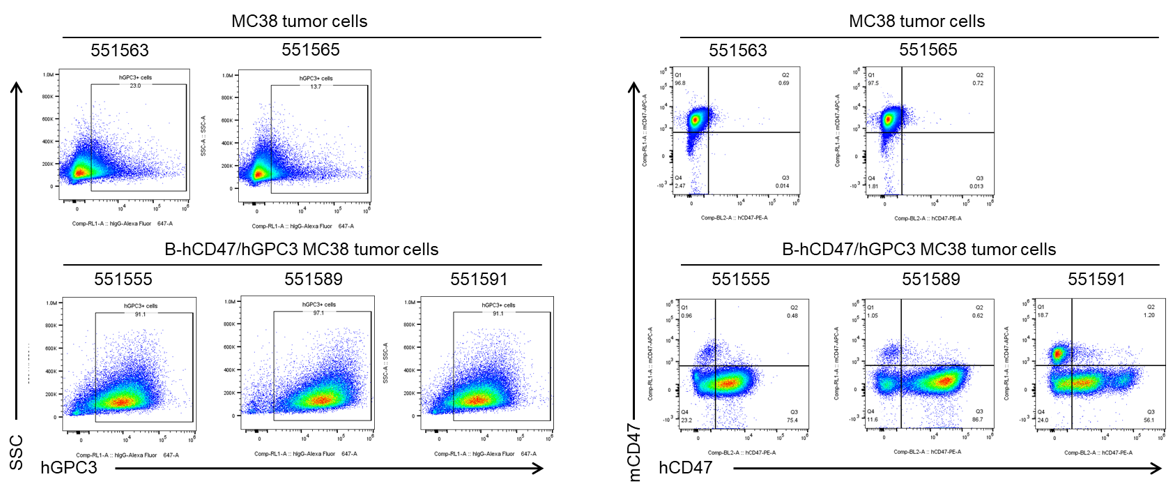
        GPC3 and CD47 expression evalsuated on B-hCD47/hGPC3 MC38 tumor cells by flow cytometry. B-hCD47/hGPC3 MC38 cells were subcutaneously transplanted into B-hGPC3 mice (n=6). Upon conclusion of the experiment, tumor cells were harvested and assessed for human GPC3 and CD47 expression by flow cytometry (Invitrogen, MA5-40988; Biolegend, 323124). As shown, human GPC3 and CD47 were highly expressed on the surface of tumor cells. Therefore, B-hCD47/hGPC3 cells can be used for in vivo efficacy studies evalsuating novel GPC3 and CD47 therapeutics.

        Tumor growth curve & body weight changes

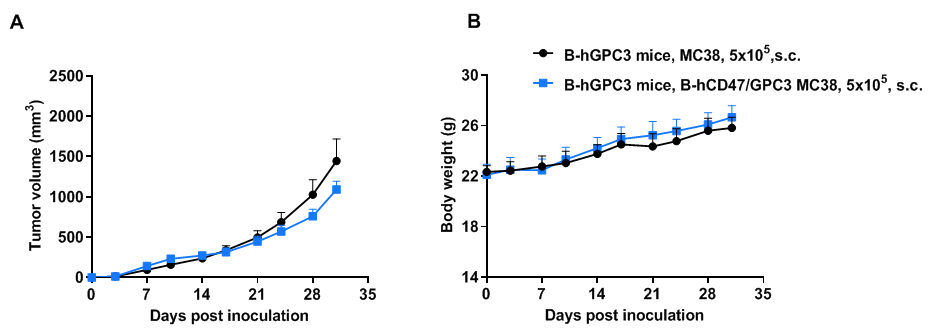
        Subcutaneous tumor growth of B-hCD47/hGPC3 MC38 cells. B-hCD47/hGPC3 MC38 cells (5×10⁵) and wild-type MC38 cells (5×10⁵) were subcutaneously implanted into B-hGPC3 mice (H/H) (female, 7-week-old, n=6). Tumor volume and body weight were measured twice a week. (A) Average tumor volume. (B) Body weight. Volume was expressed in mm3 using the formula: V=0.5 × long diameter × short diameter2. Results indicate that B-hCD47/hGPC3 MC38 cells were able to establish tumors in vivo and can be used for efficacy studies. Values are expressed as mean ± SEM.

        站点地图