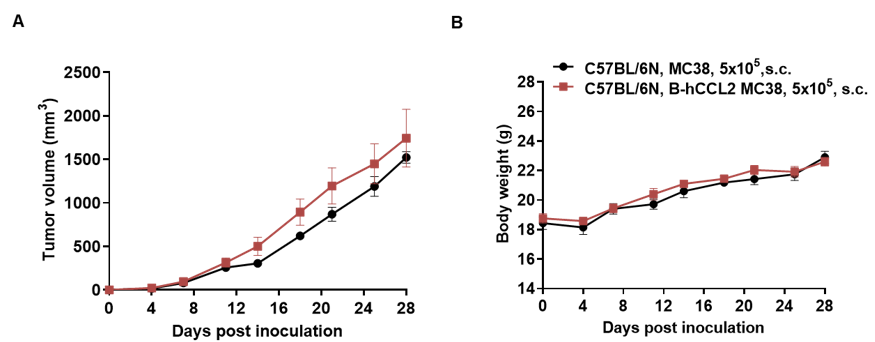
• 321866
| Product name | B-hCCL2 MC38 |
|---|---|
| Catalog number | 321866 |
| Strain background | C57BL/6 |
| NCBI gene ID | (Human) |
| Aliases | JE; HC11; MCAF; MCP1; MCP-1; Scya2; Sigje; SMC-CF |
| Tissue | Colon |
| Disease | Colon carcinoma |
| Species | Mouse |
| Application | B-hCCL2 MC38 |

The mouse Ccl2 gene was replaced by human CCL2 coding sequence in B-hCCL2 MC38 cells. Human CCL2 can be secreted by B-hCCL2 MC38 cells.

Gene targeting strategy for B-hCCL2 MC38 cells. The exogenous promoter and human CCL2 coding sequence was inserted to replace part of murine exons 2~3. The insertion disrupts the endogenous murine Ccl2 gene, resulting in a non-functional transcript.

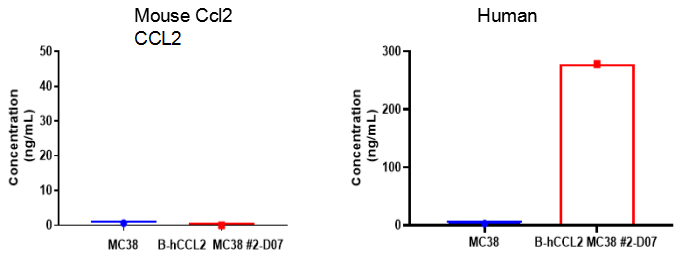
CCL2 expression analysis in B-hCCL2 MC38 cells by ELISA. Human CCL2 was detected in the supernatant of B-hCCL2 MC38 cells but not wild-type MC38 cells. Mouse Ccl2 was not detected in the supernatant of wild-type MC38 cells. The 2-D07 clone of B-hCCL2 MC38 cells was used for in vivo experiments.